Mission rehearsal
for small satellite teams.
A university cubesat or a small startup has no flight dynamics department. Its constraints live in chat threads, range notices and spreadsheets; its orbit data is the public catalog. CRIC turns those into decisions you can review: can this rocket get the satellite there, when to launch, and what to do when something comes close or you want to move. Each comes with its evidence, the checks it passed, and a person's sign-off. CRIC finds the risks and rules to check; it does not guarantee safety.
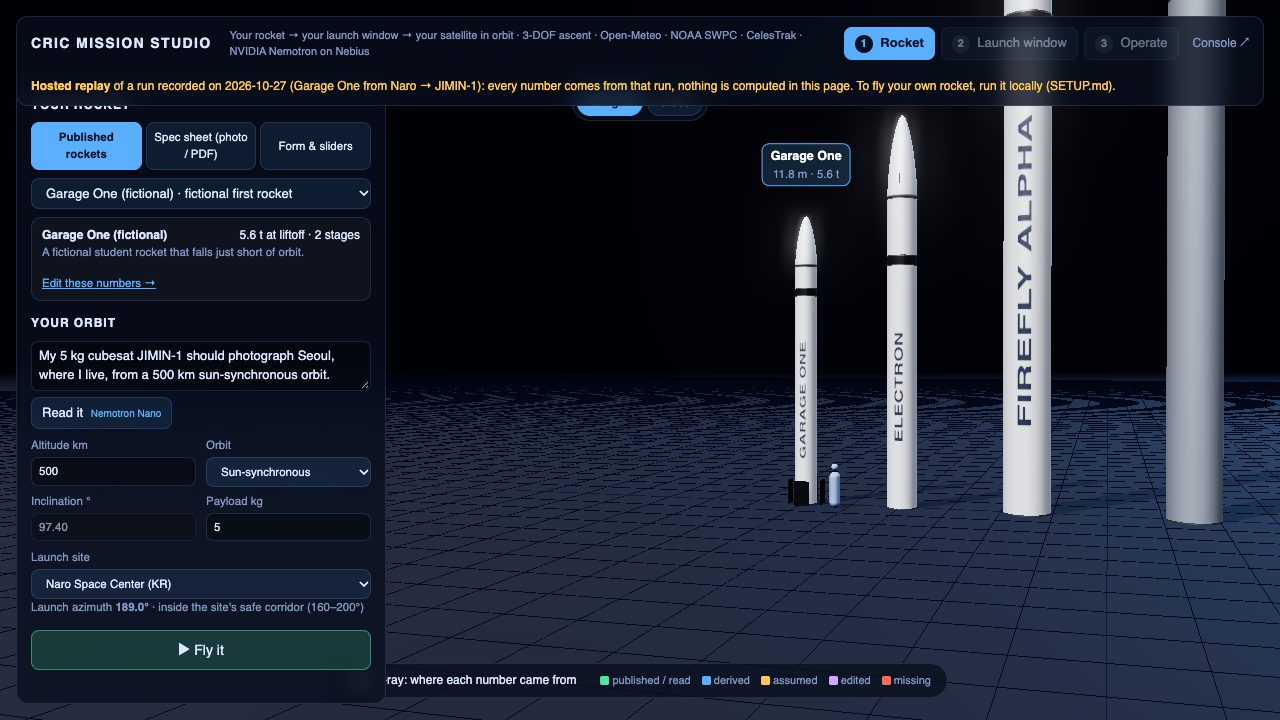
Can this rocket get us there?
Pick a real launcher, drop in its spec sheet, or type a small rocket's numbers. Watch it fly to your orbit. If it falls short, CRIC suggests fixes, and test-flies each one first.
- Nemotron 3.5 Super VL reads the spec sheet
- 500 test flights show where the spent stages land
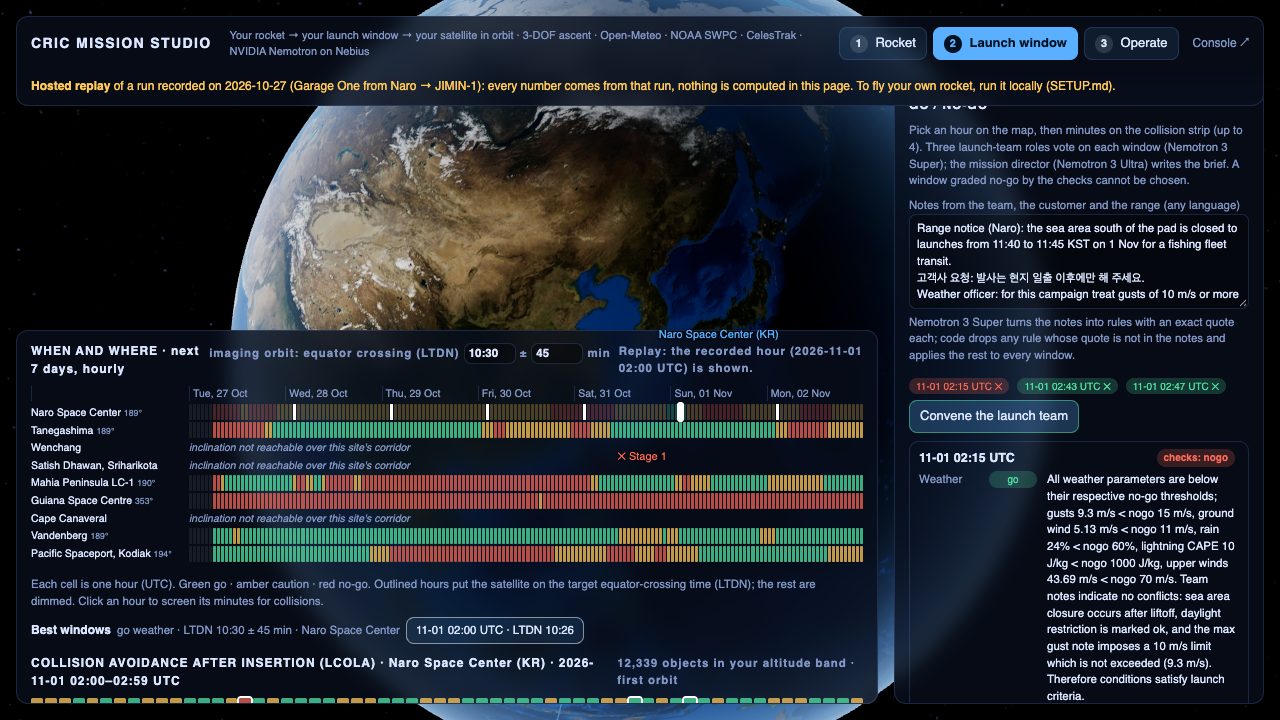
Pick the launch minute
A week of weather for every launch site, then every minute checked against the satellites already up there. One minute can pass another satellite at under a kilometer. A few minutes later, the sky is clear.
- Three launch-team votes by Nemotron 3 Super
- Nemotron 3 Ultra makes the call, and can't overrule a veto
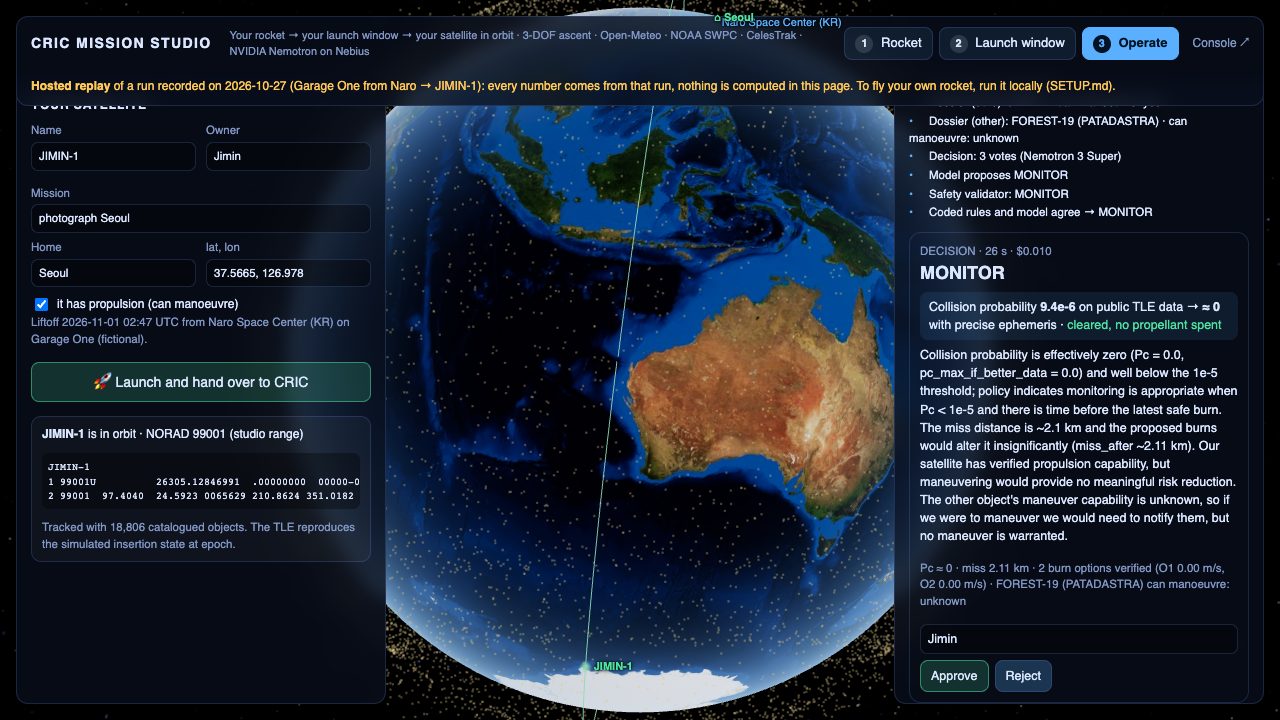
Look after it
Your satellite joins the catalog. CRIC tells you when it flies over home and warns you about close approaches. Command a burn yourself and CRIC checks it against every tracked object first. You make the final call.
- Collision math checked against NASA test cases
- No burn unless the model and the rules agree
WHAT'S REAL
Real data
- CelesTrak orbits (SGP4), NOAA SWPC space weather, Open-Meteo forecasts
- Published launcher figures, each number labeled with its source
- NVIDIA Nemotron 3 Nano, Super, Ultra and 3.5 Super VL on Nebius Token Factory; Tavily for web evidence
- Ascent model checked against published capacities: −17 % to +4 %
What's simulated
- Garage One and CUBE-1 are made up. The satellite only exists in the simulation.
- Launch rules and flight scatter are our assumptions, not a launch range's
- Rocket shapes come from the numbers. Flame, smoke and sky are for show.
- CRIC never sends commands to a spacecraft. All limits
HOW THE MODELS ARE USED
| Nemotron | What it does | Safety check |
|---|---|---|
| 3 Nano | Turns “my 5 kg cubesat, 500 km sun-synchronous, I live in Seoul” into an orbit | The orbit math is done in code |
| 3.5 Super VL | Reads spec sheets and the team's screenshots | Every number labeled; gaps filled with marked defaults |
| 3 Super | Explains a failed flight, reads team notes, votes on launches and close approaches | Fixes come from the simulator; rules in code must agree |
| 3 Ultra | Makes the launch call; writes briefs when a person has to decide | Can't pick a vetoed window |